Driving end-to-end digital transformation in education
When technology understands education
Digital transformation in education requires much more than technology. It means understanding complex academic processes, institutional regulations, diverse student journeys, team transformation, and systems that must scale without losing experience or control.
Education does not start in the classroom or the virtual campus. It starts much earlier—when someone searches for information, compares options, and tries to understand what program they can study, how it is structured, and what academic path lies ahead. In that first contact, a well-organized academic offering is more than information: it reflects a solid academic structure already operating behind the scenes.
The academic structure that supports the system
For this information to exist consistently, curricula, academic rules, prerequisites, and formal structures must be defined. This is where the core of the system appears: the program management system, acting as the single source of truth for all curricula, modalities, and programs. It feeds every downstream decision and prevents institutions from relying on spreadsheets, scattered documents, or manual interpretations.
On this structural foundation, universities begin to project their operations. Courses to be offered, resources to be allocated, faculty to be organized. Academic planning does not happen in isolation—it is built on real data: historical enrollments, student trajectories, and prior equivalencies. This enables institutions to anticipate scenarios and scale operations without losing control.
A student experience orchestrated from the very first step
Once this structure is in place, the system opens outward. Student intake becomes a process where academic offerings, program rules, and applicant information converge. A well-integrated admissions process ensures that the first step into the institution is clear, traceable, and fully aligned with everything that follows.
From that moment on, administrative and academic dimensions coexist. Tuition, fees, and financial status are integrated into the journey without breaking the experience, through a payments portal connected to the broader ecosystem. A student’s account status enables—or restricts—key actions such as enrollment, course attendance, or exam registration.
Once inside, students need a single platform where everything comes together. Their daily experience is centralized in the student portal, bringing together enrollments, communications, academic status, administrative procedures, and progress tracking. From a technical perspective, this portal is not just an interface—it is an orchestration layer that connects all system domains.
Pathways, assessments, and closing the journey
As the journey progresses, trajectories become non-linear. Students change programs, transfer from other institutions, or bring prior academic experiences. Equivalency management becomes critical: interpreting complex academic rules, recognizing credits, and reintegrating that information into the system without losing consistency or traceability. Joint programs, inter-institutional agreements, and shared pathways require support for dual degrees and articulation, where multiple regulations coexist and academic data must flow across institutions without breaking each one’s internal logic.
Meanwhile, learning continues. Assessments cannot be isolated or manual processes. An integrated examination platform enables the design of assessments aligned with different pedagogical models, records results, and feeds key information back into the academic system in real time.
Connected processes: graduation as a collective achievement
The academic journey eventually reaches its end—but the system should not become more fragile at that point. Processes such as thesis approval and degree issuance concentrate formal validations, critical documentation, and multiple institutional actors. When digitized, graduation stops being a bottleneck and becomes a clear, orderly, and auditable closing stage.
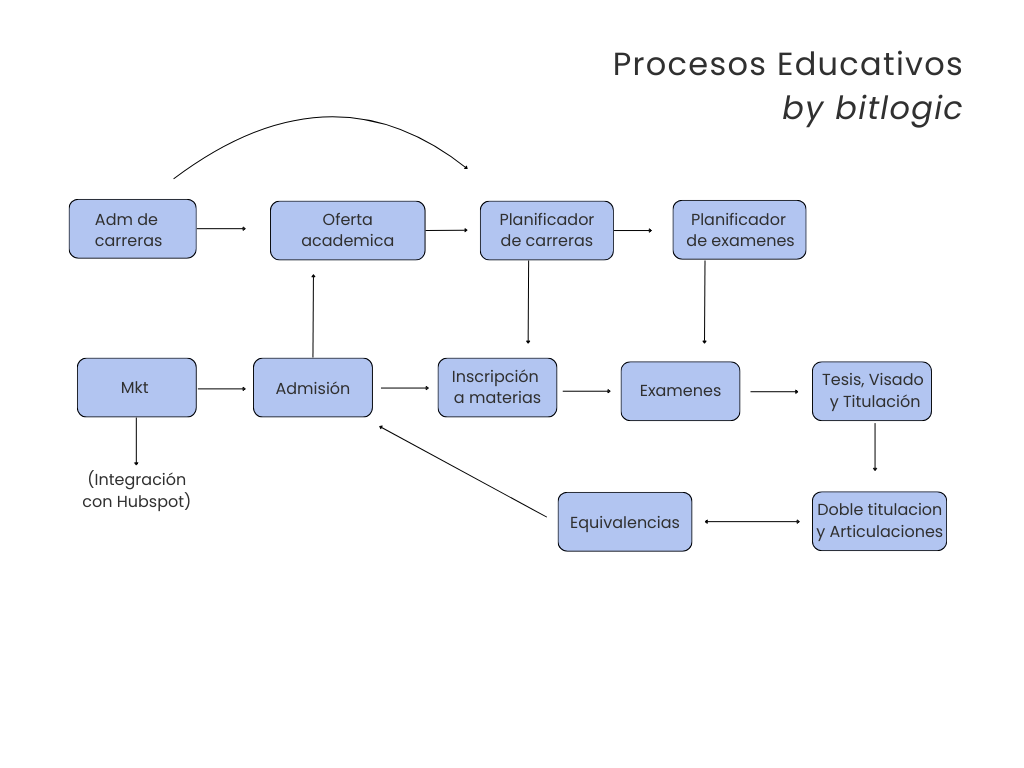
What matters is that the cycle does not end there. Graduates return for new programs, postgraduate studies, articulated pathways, and reconfigured trajectories. Data flows back into planning, equivalencies, and admissions, closing a continuous loop where each process builds on the previous one.
End-to-end educational digitalization is not about adding tools. It is about designing an architecture where data flows, processes connect, and technology follows academic logic. When that happens, institutions stop managing friction and start managing knowledge.
We are designing the future of education. Let’s talk 😉